Historical core
Rambla del Poblenou, Plaça Prim and surrounding streets form recognizable parts of the older residential area.
Industrial heritage and urban renewal
Poblenou is a neighbourhood in the Sant Martí district where a historic residential area, industrial heritage, new work and residential areas and routes towards the sea are located next to each other. The development of the area is visible in various ways around Rambla del Poblenou, Plaça Prim and former factory buildings. Because the name Poblenou is sometimes applied more broadly in daily use than the official district boundary, the page requires a careful geographical explanation.
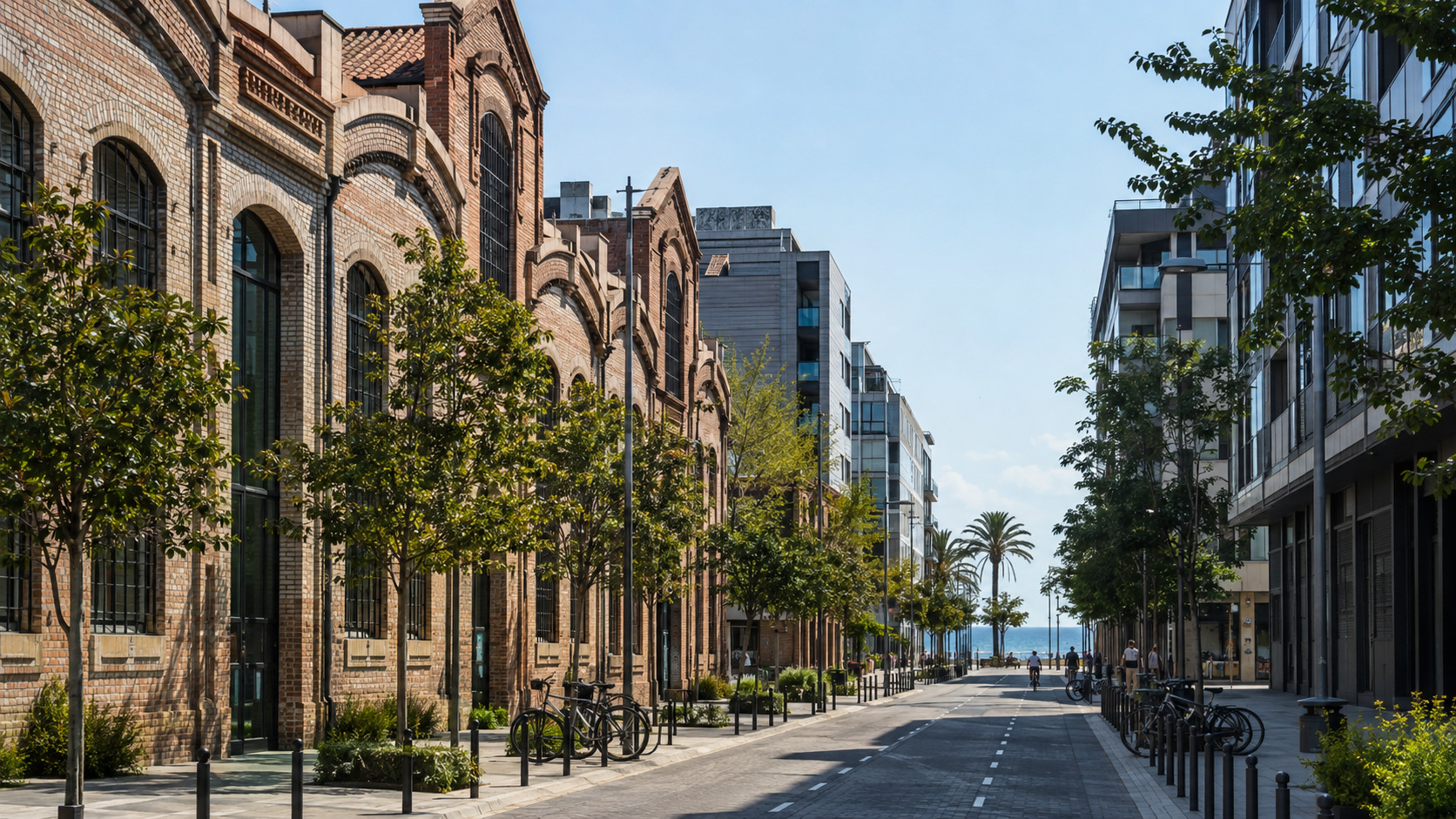
Poblenou can refer to the official district of el Poblenou, but is also used for a wider part of the former industrial area in Sant Martí. The innovation and renewal area 22@ overlaps with several neighbourhoods and is not a simple alternative name for the entire district. That is why this guide distinguishes between the historic core, adjacent neighbourhoods, the broader 22@ area and the coast.
Rambla del Poblenou, Plaça Prim and surrounding streets form recognizable parts of the older residential area.
Former factories, workshops and chimneys are reminders of the industrial development of the area.
New offices, homes and public space are located in various places next to reused industrial buildings.
The neighbourhood is close to the coast, but beaches and adjacent coastal neighbourhoods require a geographically nuanced description.
Poblenou does not have a short series of monuments that automatically form one route. Therefore, choose a clear focus: the historic core, industrial heritage, urban renewal or a walk towards the sea. Only combine parts that are logically connected geographically.
The Rambla del Poblenou is an important walking and tourist route through the district. There are homes, shops, restaurants and public spaces along the various parts; the entire rambla is not always quiet or exclusively local.
Plaça Prim and the surrounding streets are a recognizable part of older Poblenou. Use the square as a resting point and orientation within a walk, without presenting catering establishments or residents as a tourist attraction.
The former factory complex is a visible example of Poblenou's industrial history and subsequent reuse of buildings. Check current functions or visit options with the official manager.
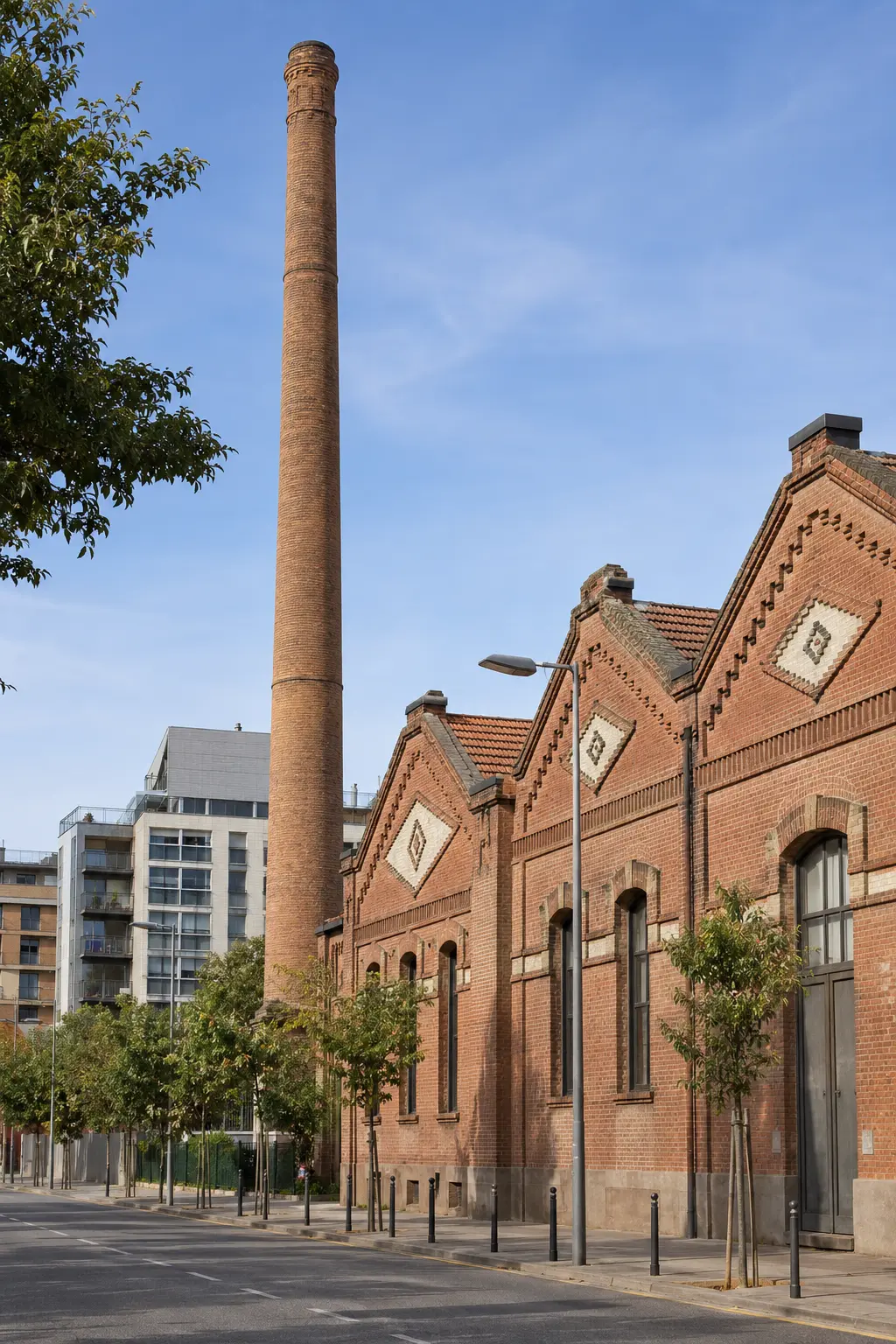
Various layers of the industrial past and urban renewal are visible along and around Carrer de Pere IV. Use this as a theme for a walk without uncontrollably linking every old building to a factory or architect.
The park is located in the wider area associated with Poblenou and can serve as a green break in a longer walk. It is not a mandatory part of every walk through the historic core.
From the neighbourhood you can walk towards the beaches and promenade of Sant Martí. Bogatell, Mar Bella and surrounding coastal zones are all central Poblenou, not without nuance.
Practical: Check current local information for beach visits and possible construction activities.
Hiking idea
This sample walk connects parts of the historic core with industrial heritage and the direction of the coast. The route is flexible and does not have to be extended to every 22@ building, park or beach.
Carrer de Pere IV→Rambla del Poblenou→Plaça Prim→Can Felipa→Coast
Use the environment as an introduction to the industrial past and urban renewal. Choose a few clearly recognizable buildings and do not invent historical details for non-inspected buildings.
Walk south and notice the alternation between residential buildings, public space and daily use of the rambla.
Use the square and the surrounding streets for a brief introduction to the older neighbourhood core. Limit the route if you want to walk quietly.
Use the complex as a concrete example of industrial heritage and reuse. Check current access when you want to attend an indoor function.
Continue through the southern part of the district to the promenade. Make the beach an optional end; distance and coastal location depend on the route chosen.
Poblenou combines residential streets, old industrial buildings, renovated work areas, public space and routes to the sea. The atmosphere differs between the rambla, the older core, major traffic routes and recently developed parts. The entire neighbourhood is not uniformly quiet, creative, hip, industrial, innovative or undiscovered.
Concentrate on Rambla del Poblenou, Plaça Prim and surrounding streets.
Choose Can Felipa and a controlled route around Pere IV as the main part.
Select one part of 22@ or a walk towards the sea and carefully describe adjacent neighbourhoods geographically.
The combination of industrial heritage, reuse and new construction offers various starting points for a targeted walk.
A route through the historic centre can be extended towards the sea when time and weather permit.
Poblenou shows a different street pattern and development history than Ciutat Vella.
Distances, traffic, weather, mobility and the chosen focus influence the experience. The area informally linked to Poblenou is large and does not constitute a single compact walk.
The historic core, renewal areas and coast are not entirely on one compact route. Choose a clear direction in advance.
Choose in advance whether the walk starts at Pere IV, the Rambla or the coast.
Please allow for greater distances than in compact parts of Ciutat Vella.
Use clear landmarks, because the historic core and renewal areas do not completely coincide.
For cultural sites, parks and beach visits, check current access and local information.
Determine whether the historic core, the industrial heritage or the coast is central.
The rambla provides direction between different parts of the neighbourhood, without the need for every side route.
Choose recognizable, verifiable buildings instead of assigning a story to every old building.
The renewal area affects several neighbourhoods and does not fully coincide with the official Poblenou district.
Add the boardwalk or a beach only when distance, weather and energy permit.
Features, routes and access may change; consult official local information if necessary.
These are possible combinations. Do not automatically cover multiple entire neighbourhoods or areas in one day.
Choose this sequel when urban renewal and contemporary architecture are the main focus. Glòries and 22@ touch several neighbourhoods and do not fully coincide with the official Poblenou district.
Extend the walk towards Bogatell, Mar Bella or another controlled part of the coast when weather and energy permit.
Follow the coast westwards only if a longer promenade would suit. Barceloneta is a separate neighbourhood and not part of the historic core of Poblenou.
Poblenou is an interesting choice for visitors who want to combine industrial heritage, urban renewal and a neighbourhood outside the historic centre. The area is most visible with a targeted route around the rambla, the old centre or a selected part of the former industrial zone. Only add the coast when available time and desired distance allow it.
Choose a walk around Rambla del Poblenou and Plaça Prim, industrial heritage around Pere IV and Can Felipa, or a separate route towards the coast.
The district is known for its historic residential centre, industrial past, reused buildings, urban renewal and location close to the coast.
No. The 22@ renewal area is connected to several neighbourhoods and parts of Sant Martí and is not simply equivalent to the entire official Poblenou district.
That depends on the chosen focus, distances, walking pace and a possible beach or cultural visit. Half a day for one route is only an indication.
Yes, the district is close to the coast. Choose a geographically appropriate beach and check current conditions; make the coast a flexible end.